Pocket Option Demo Account
Learn to trade risk-free with Pocket Option’s $50,000 demo account. Get real market conditions, full platform access, and expert strategies to build confidence before going live.
Risk warning: Trading carries high risk of losing your capital.

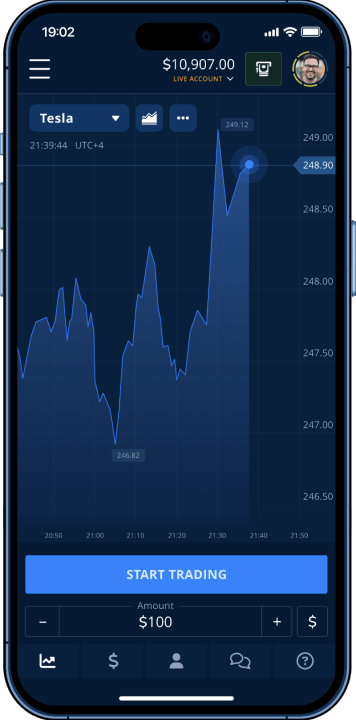
Setting Up and Navigating Your Demo Account
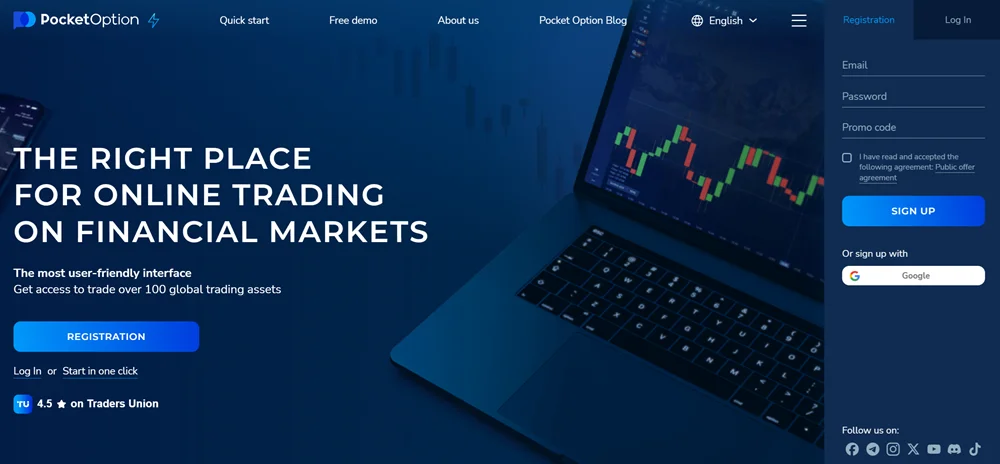
Registration Process and Quick Start
Account creation takes under two minutes through email registration or social login via Google. The platform automatically generates a demo account upon registration, eliminating additional verification steps. New users receive $50,000 virtual funds immediately, with the option to adjust this amount between $1,000.
Open an Account
- Visit Pocket Option website and click "Register" in the upper-right corner.
- Enter email address and create password (minimum 8 characters)
- Accept Terms of Service and click "Create Account"
- Access trading platform automatically with $50,000 demo balance
The first trade in demo
- Select first asset from the asset menu (recommended: EUR/USD for beginners)
- Configure chart settings: 1-minute timeframe, candlestick display
- Add basic indicators: Moving Average (20-period) and RSI (14-period)
- Place first practice trade with $10 amount to test functionality
Platform Interface and Tools
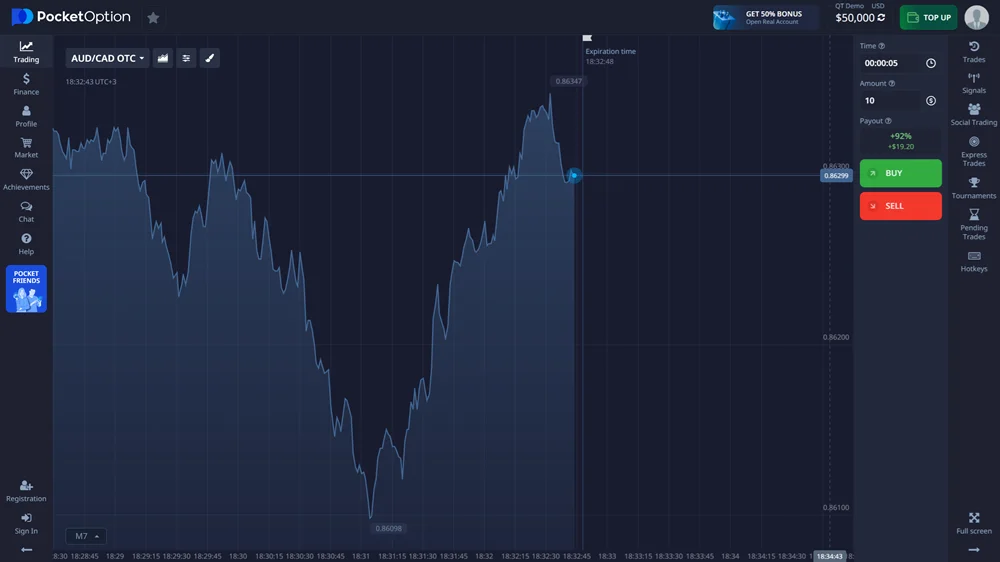
The trading interface centers around a customizable chart displaying real-time price movements.
- Left-side panels show available assets organized by categories: currencies, commodities, stocks, and crypto.
- Right-side controls manage trade parameters including amount, duration, and direction.
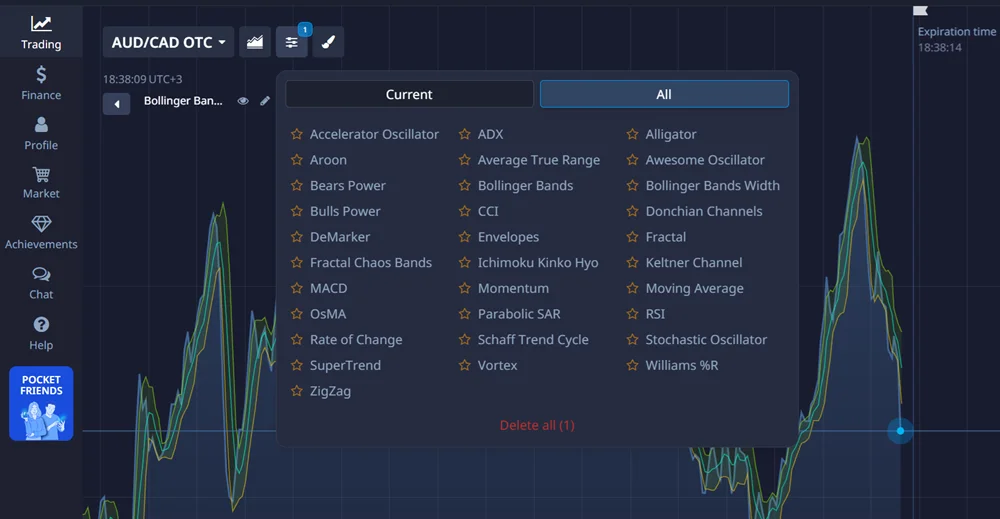
- Technical analysis tools populate the top toolbar, featuring RSI, MACD, Bollinger Bands, and 40+ additional indicators.
Customization Options
Demo account settings allow personalized trading experiences.
Users can switch between light and dark themes, adjust chart timeframes from 5 seconds to 4 hours, and configure notification preferences.
The platform saves indicator settings, favorite assets, and layout preferences automatically.
Strategic Demo Trading: From Beginner to Intermediate
Effective demo trading follows structured progression rather than random experimentation. Week one focuses on platform navigation and basic order placement. Week two introduces technical analysis with simple indicators. Week three adds multiple asset classes and correlation analysis. This systematic approach builds competency layers systematically.
Testing Different Asset Classes
Currency pairs like EUR/USD and GBP/JPY offer stable liquidity and predictable patterns during London and New York sessions. Cryptocurrency markets including Bitcoin and Ethereum provide 24/7 trading opportunities with higher volatility. Stock indices such as S&P 500 and NASDAQ react strongly to earnings announcements and economic data. Commodities like Gold and Oil respond to geopolitical events and supply disruptions.
Strategy Development and Backtesting
Demo accounts enable strategy testing across various market conditions. Trend-following strategies work well during directional movements in major currency pairs. Breakout trading captures momentum in cryptocurrency markets during high-volume periods. Range-bound strategies profit from support and resistance levels in stock indices during consolidation phases.
Recommended Learning Progression
| Week | Primary Focus | Recommended Assets | Skills to Develop |
|---|---|---|---|
| 1-2 | Platform basics | EUR/USD, GBP/USD | Order placement, chart reading |
| 3-4 | Technical analysis | Major currency pairs | Indicator interpretation |
| 5 | Multi-asset trading | Crypto, indices | Market correlation |
| 6 | Strategy testing | All asset classes | Risk management |
Essential Testing Strategies:
- Moving Average crossover system on EUR/USD during European session
- RSI divergence patterns on Bitcoin during high-volatility periods
- Support/resistance breakouts on S&P 500 around market open
- News trading on Gold during Federal Reserve announcements
Technical Analysis Tools and Real Market Simulation
Charts display multiple timeframes simultaneously, from 5-second scalping charts to monthly trend analysis. Drawing tools include trend lines, Fibonacci retracements, harmonic patterns, and geometric shapes. Chart templates save configurations for quick analysis across different assets.
Indicator Integration and Custom Settings
The platform hosts over 20 built-in indicators covering trend, momentum, volatility, and volume analysis. Popular choices include Stochastic Oscillator for overbought/oversold conditions, Williams %R for momentum confirmation, and Average True Range for volatility measurement. Custom indicator uploads allow advanced traders to import proprietary analysis tools.
Market Hours and Asset Availability
Trading availability matches real market schedules. Forex markets operate 24/5 from Sunday 5 PM EST to Friday 4 PM EST. Cryptocurrency trading continues throughout weekends. Stock markets follow exchange schedules: NYSE operates 9:30 AM to 4:00 PM EST on weekdays. Commodities have specific trading sessions based on underlying market hours.
Transition Strategy: From Demo to Live Trading
Live trading readiness requires consistent demo profitability over minimum 200 completed trades. Win rates should exceed 60% for trend-following strategies or 55% for counter-trend approaches. Maximum consecutive losses should remain under 10 trades. Risk management must limit individual trade losses to 2% of account balance consistently.
First Live Trade Planning
Initial live trades should use minimal position sizes regardless of demo success levels. Starting with $1-5 trades allows emotional adjustment to real money at stake. First-week live trading should replicate exact demo strategies without modifications. Gradual position size increases follow demonstrated consistency over monthly periods.
Scaling and Risk Management
Account growth requires systematic position size scaling based on account balance increases. Demo testing should include various account sizes to understand scaling challenges. Risk per trade may decrease as account size grows to maintain absolute dollar loss comfort levels. Professional traders often risk smaller percentages on larger accounts.
Transition Readiness Checklist
| Skill Area | Demo Benchmark | Ready for Live | Action Required |
| Profitability | 60%+ win rate over 200 trades | Consistent monthly profits | Continue demo practice |
| Risk management | Max 2% risk per trade | Never exceeded limits | Ready to begin live |
| Strategy consistency | Same approach for 3 months | No strategy changes | Ready to begin live |
| Emotional control | Follows rules during losses | No revenge trading | Ready to begin live |
| Platform knowledge | Uses all required tools | Automatic execution | Ready to begin live |
Conclusion
Pocket Option demo accounts provide training environments that mirror live market conditions while eliminating financial risk. Unlimited demo access allows thorough strategy testing across multiple asset classes and market conditions.
Successful demo trading requires systematic progression through platform mastery, technical analysis skills, and psychological preparation. The transition to live trading demands proven consistency in risk management and strategy execution. Demo success doesn’t guarantee live trading profits, but it builds essential foundational skills.
My experience with hundreds of demo account users shows that systematic practice produces better live trading results than random experimentation. Start with focused learning objectives, maintain detailed trade records, and transition gradually to live trading when consistency emerges.
Ready to practice? Open your demo account and begin building systematic trading skills with professional tools and real market conditions. Or consult our review for additional details about PO Broker.
FAQ - PO Demo
Demo quotes match live market feeds with identical spreads and execution speeds. The platform uses the same liquidity providers for both account types, ensuring price accuracy within milliseconds of real market movements.
Larger demo position sizes create artificial confidence that doesn’t translate to live trading. Practice with realistic position sizes relative to your intended live account balance to develop appropriate risk awareness and emotional responses.
Demo accounts lack access to certain social trading features and promotional bonuses available to live accounts. All core trading functionality, technical analysis tools, and market data remain unrestricted.
Demo accounts remain permanently accessible regardless of live trading status. Many experienced traders continue using demo accounts for testing new strategies or practicing during market volatility periods.
Demo success indicates platform competency and strategy viability but cannot predict emotional responses to real money risk. Successful demo trading provides necessary but not sufficient conditions for live trading success.
Demo balances reset manually through account settings when funds drop below $1,000. The platform allows unlimited balance replenishment, ensuring continuous practice opportunities without interruption.